
My Story
by Francisco Felix — Desveladisimo
The gift I didn't want
I was a teenager when my father gave me a Commodore 64. He couldn't really afford it. He bought it second-hand, from a friend of his.
I had been asking for an Atari 5200. The Commodore was not what I wanted, and I made the mistake of letting that show. Before I had the words to take it back, I had hurt him. I went to bed that night owing him something better than the boy who had complained, and I knew it before the light went out.
The obsession
By the next night I had read half the BASIC manual that came with the machine. By the next afternoon I had read the rest, and I was writing programs.
Over the months that followed I taught myself 6502 machine language. I asked for programming books that weren't available where I lived; my father brought them back from his work trips to Guadalajara and Mexico City. No internet existed. No bookstore in my town carried anything technical. Programming books arrived by hand.
The Commodore's BASIC was missing the graphics commands a friend's TRS-80 had — LINE, CIRCLE, POINT. The friend, with the better machine, never let me forget it. So I extended the Commodore's BASIC interpreter myself, in machine language, until it could draw what the TRS-80 could. Then I carried the Commodore — case, keyboard, monitor, disk drive — to his house and demonstrated it.
The letter and what came back
A few years later I built a graphics converter for GEOS — the C64's graphical operating system — that translated between the incompatible image-gallery formats of Print Master and Print Shop. I printed the code, packaged it, and mailed it to COMPUTE! magazine in the United States. They bought the rights for around three hundred US dollars — a significant amount of money in Mexico at the time — and published it in their March 1991 issue.
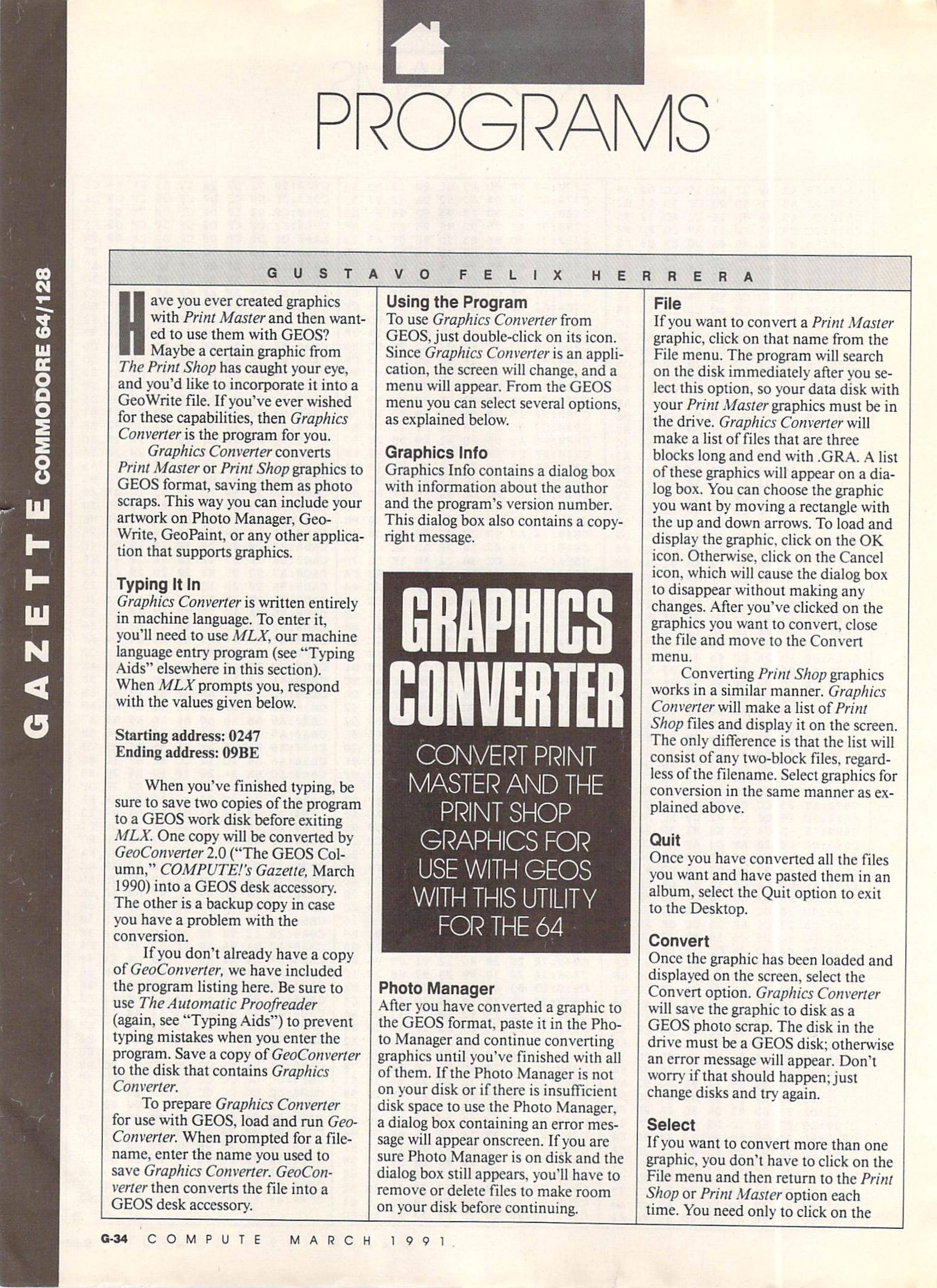
The byline reads “Gustavo Felix Herrera” — my middle name followed by both Mexican apellidos, the way I would have signed a school paper.
I was a high-school student in Mexico, mailing a printed program across an international border, hoping someone would notice.
The forty years between
In the four decades since, I have shipped software for other people. Newspapers, manufacturing, advertising, government, fintech, mortgage technology, API products on AWS. Individual contributor, manager, teams in three countries.
The pattern the people I have worked with describe — across years, across two languages — is the same one that pulled me into the Commodore the night I owed my father something better: I see where teams are going to get stuck before anyone has to say it, and I do not rest until I have made it right.
Across decades I have watched this pattern repeat: teams getting stuck, and no one around them with the tools to see it accurately or early enough to act. It is a useful instinct. It turns out to also be a fairly precise description of a product.
The first thing of my own
BottleneckIQ is the first thing I have built that is entirely my own. It exists because that same instinct landed on a meeting at work, where someone said the development team was the bottleneck. I knew it was not true. I also knew we did not have the data to prove it.
Two separate teams of external consultants had spent months working alongside my engineering team to make sense of a legacy codebase that had grown unmaintainable. Both teams eventually told us they did not know how we had kept it alive. The team that had kept it alive was the team being called the bottleneck. That was the moment I started building.
“I did not want to be blamed, and I did not allow anyone to blame my team. I did not want to point fingers — I wanted to provide informed decisions backed up by data.”
That is the entire principle. The product just expresses it in code.
I still work full-time as a developer in Mexico, on a team where this exact pattern recurs. BottleneckIQ is a side project, nights and weekends, one person.
If you have worked with Jira flow metrics at any meaningful scale, your honest feedback is more valuable to me right now than a sale. Whether you find BottleneckIQ useful, or whether you find something fundamental missing — either way, tell me. That is the ask.
You can reach me at francisco@bottleneckiq.com, on LinkedIn, or by reading the long-form post where I describe in detail why most Jira time-in-status plugins silently lie.